 There is something different about shopping when you don’t know what you are going to find.
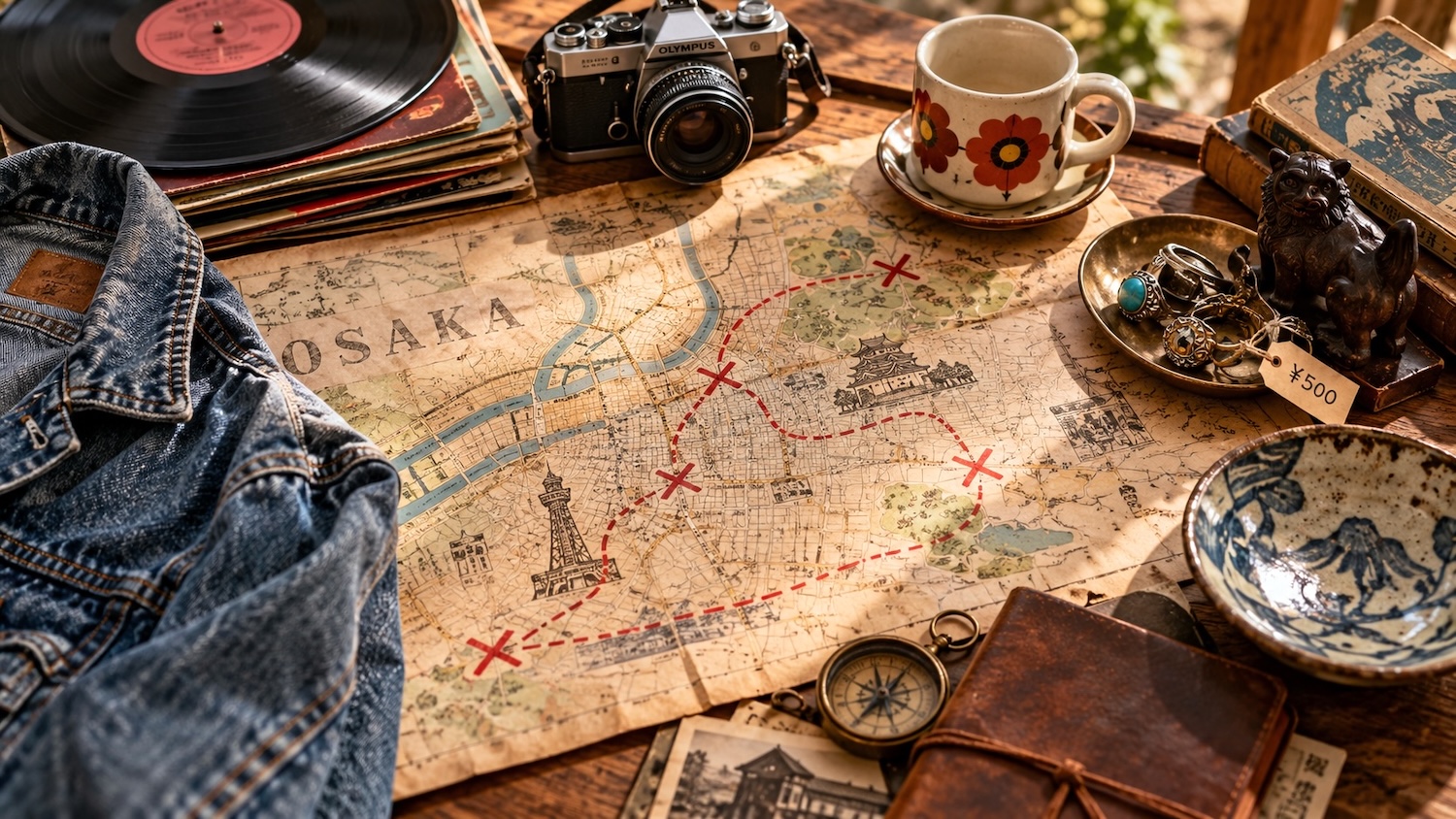
Maybe it is a perfectly worn denim jacket. A Showa-era coffee cup. An old camera, a stack of records or a piece of handmade jewelry that exists nowhere else. Half the fun is finding something you never intended to buy.
Osaka understands the appeal. Long before vintage shopping became an international trend, young people were digging through imported American clothing and used records in the warehouses around what would become Amerikamura. That appetite for things with a past helped shape one of the city’s most famous youth neighborhoods.
More than half a century later, the hunt has spread far beyond Amemura. And this October, it seems to be everywhere.
October doesn’t bring Osaka one big vintage event. It brings an entire spectrum of ways to hunt.
LOHAS Festa, Vintage Market — Expo Flea Market, Kitahama Flea Market and Shitennoji’s monthly market are among the events offering very different versions of the experience across October.
And even Osaka City gets into the spirit, with a massive resident garage sale held as part of its annual Waste Reduction Festival.
 Across them, plenty of familiar treasures recur: vintage clothing, records, antiques, ceramics, household goods, handmade pieces, collectibles and things considerably harder to categorize. But no two of these markets are quite the same. Each has its own personality, setting and reason to go — from hundreds of independent makers to dedicated vintage dealers, riverfront browsing, a centuries-old temple setting and reuse taken almost literally.
That means there is no reason to choose just one. If the hunt is part of the fun, October offers the rare opportunity to make a month of it.
Let’s start with the biggest.
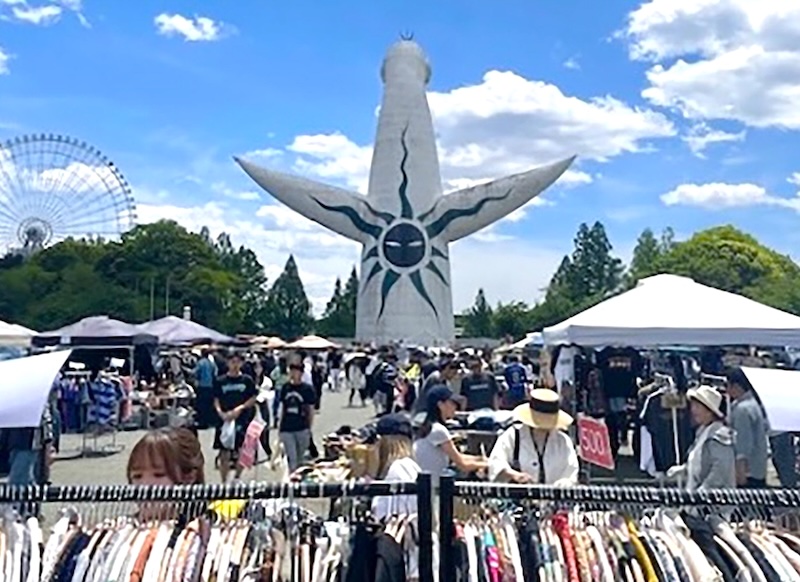
LOHAS Festa Expo spreads across seven days and two weekends at Expo ’70 Park — October 9–12 and 16–18 — turning the East Plaza into one of the largest market experiences of Osaka’s autumn. The 2025 edition welcomed more than 62,000 visitors and 576 exhibitors despite losing its final day to bad weather. Earlier editions have been larger still: autumn 2023 drew more than 178,000 people and 844 exhibitors.
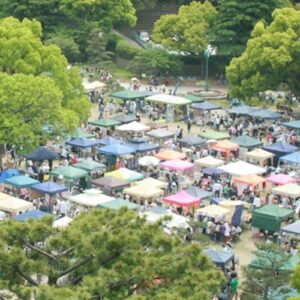 The scale is remarkable, but LOHAS Festa has spent two decades building an identity around more than size. Since its first event in 2006, the festival has promoted a lifestyle that considers people and the planet, bringing independent makers and small businesses together around handmade goods, reuse, sustainability and things intended to last.
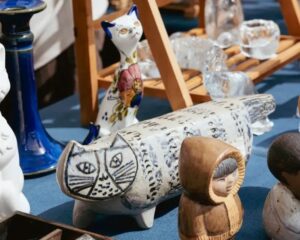 That philosophy changes the nature of the hunt. Here, the discovery might come from meeting the person who made what you are buying, finding something produced in small quantities or choosing an object precisely because it was designed to stay with you rather than be replaced.
And there is plenty of time to look. For 2026, the festival’s online shop directory contains more than 600 listings across the two weekends, while workshops, live entertainment and food turn browsing into the kind of experience that can easily consume an entire day at Expo ’70 Park.
LOHAS Festa may win on sheer scale, but the next stop brings the hunt directly back to vintage.
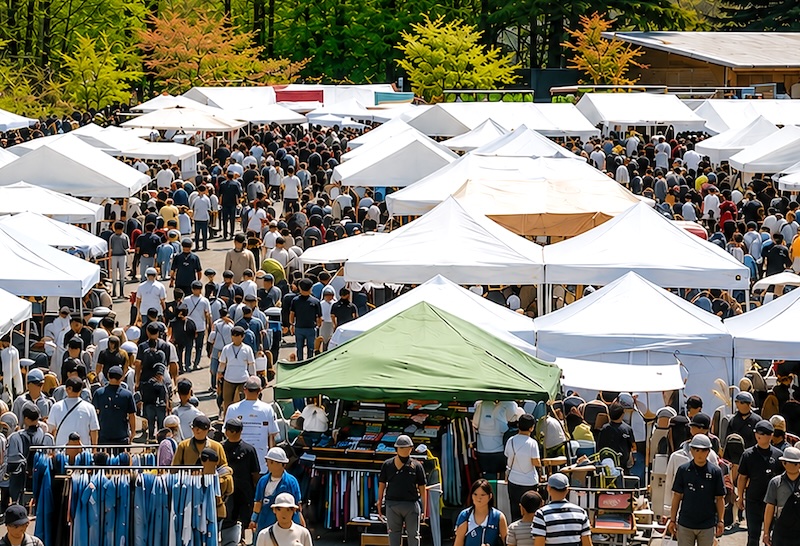
Five days after LOHAS Festa wraps up, another market moves into the very same East Plaza at Expo ’70 Park. If you need evidence of just how popular the hunt has become, this may be it.
 Vintage Market — Expo Flea Market runs October 23–25 with more than 170 shops devoted specifically to antiques and vintage finds. Dealers come from across Japan, bringing pieces sourced both domestically and around the world.
And people are clearly willing to make the hunt. The spring 2026 edition drew around 27,000 visitors over three days, demonstrating just how large the appetite for a dedicated vintage event has become.
This autumn expands the mix further with an area dedicated to old books and records, while live jazz and food turn the sprawling market into something closer to a day out than a shopping trip.
Here, vintage is the point. Dealers have traveled, searched and selected before anything reaches the grass at Expo Park. A piece of furniture might have crossed an ocean. A jacket may have survived several decades. A record might be waiting for the person who has been looking for exactly that pressing.
From the open lawns of Expo ’70 Park, the hunt moves into the heart of the city.
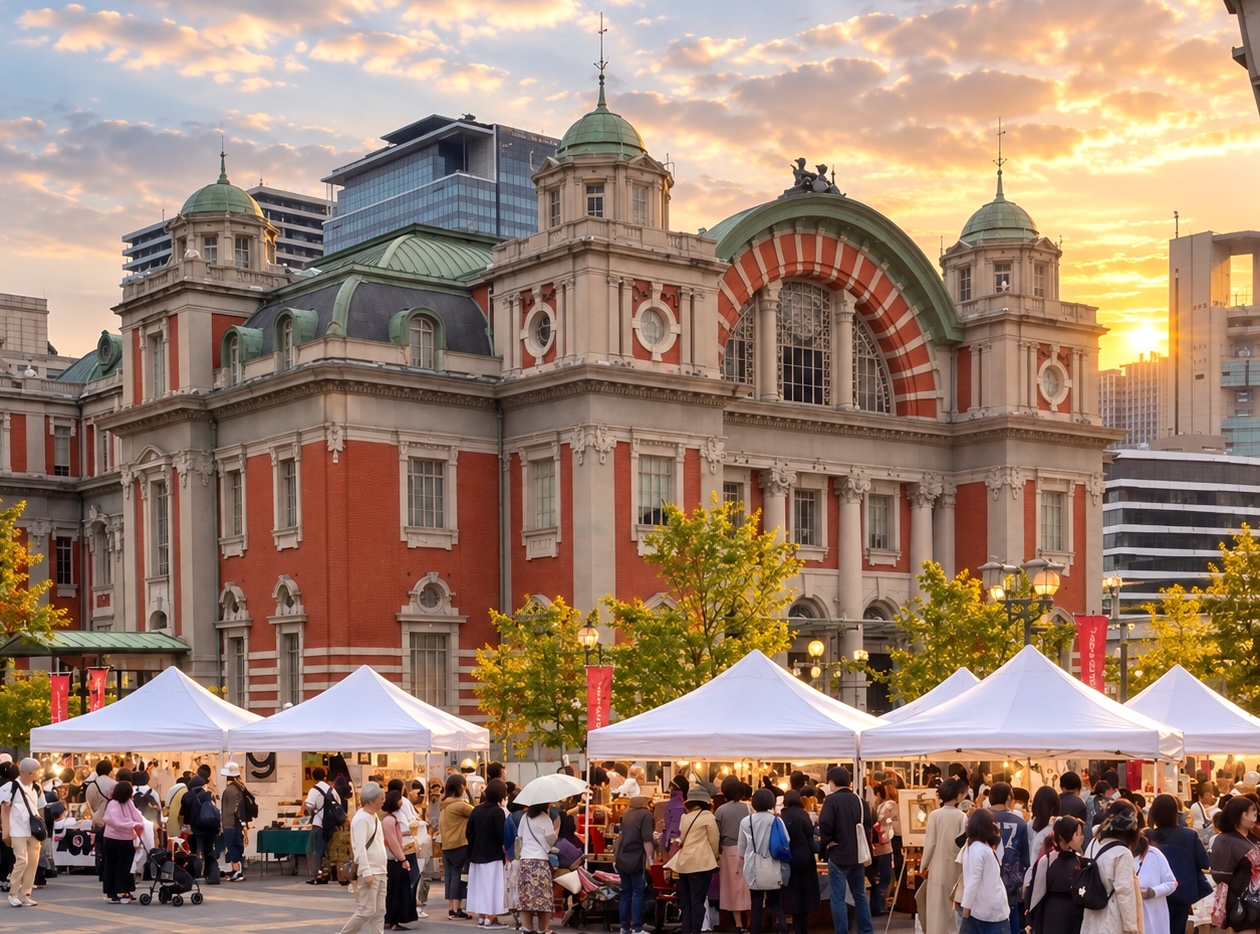
 Kitahama Flea Market returns October 17 and 18 with around 100 exhibitors gathering around Osaka City Central Public Hall and the Nakanoshima waterfront. The selection brings vintage and antiques together with handmade finds, but here the setting is every bit as much a part of the attraction.
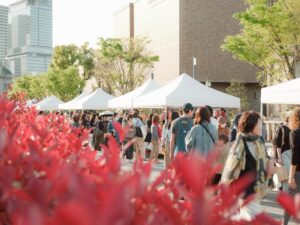 Vendors spread through one of central Osaka’s most distinctive urban landscapes, with the red-brick Public Hall, rivers and bridges of Nakanoshima surrounding the market. That makes Kitahama easy to experience without turning the day entirely over to shopping: walk the waterfront, stop when something catches your eye, browse for a while and keep exploring.
There is curation here, but still plenty of room for discovery. The hunt simply becomes more intimate — woven into an afternoon in the city rather than spread across an enormous festival ground.
October still has a few more Xs on the treasure map.
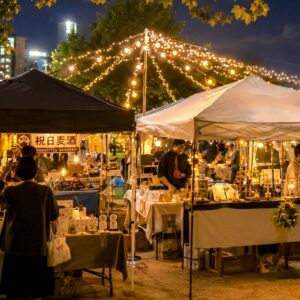 Mono Ichi offers two chances to search for locally made treasures at Suehiro Park in Daito. October 10 brings the final Yoi Mono Ichi night market of the year, running from 4–9pm, before the regular daytime market returns October 24. Small by comparison with the markets above, its appeal comes from independent makers and the chance to meet the people behind what you find.
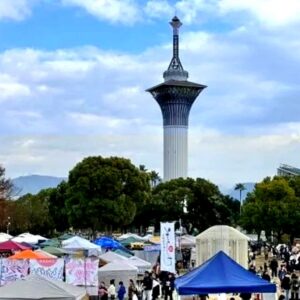 That same weekend, LOHAS PARK Tsurumi brings another handmade market to Tsurumi Ryokuchi on October 24 and 25, with independent creators, workshops and food extending the hunt to another corner of Osaka.
And then there is a rather different kind of treasure hunt.
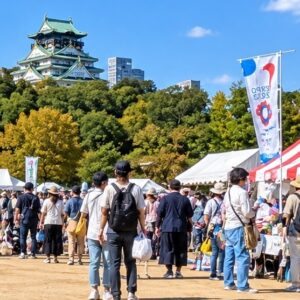 Garage Sale in OSAKA TOWN brings around 480 booths to Osaka Castle Park on October 10 as part of Osaka City’s annual Waste Reduction Festival. This is reuse in its most literal form: residents selling things they no longer need so somebody else can give them another life. There may be no specialist dealers or carefully defined categories, but there are certainly no fewer opportunities for an unexpected find. Across 480 booths, you simply have to dig a little harder.
Then there is Shitennoji, where browsing for old things comes with a rather different backdrop.
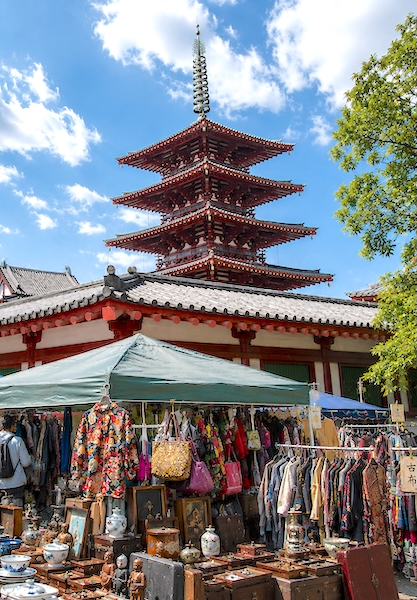 For two days each month, vendors gather within the grounds of one of Japan’s oldest Buddhist temples for markets connected to the memorial days of Kōbō Daishi and Prince Shōtoku. On October 21 and 22, those stalls become another stop on Osaka’s unusually crowded month of treasure hunting.
This is not a “vintage market” created for the current vintage boom. Old objects mingle with everyday market goods beneath Shitennoji’s temple buildings, where something from decades ago can appear on a table within a place whose own history stretches back more than 1,400 years.
That contrast gives Shitennoji something none of October’s other markets can quite reproduce. You might go looking for an old bowl, a tool or some wonderfully inexplicable object whose original purpose you can only guess.
But here, the setting may be the oldest thing you encounter.